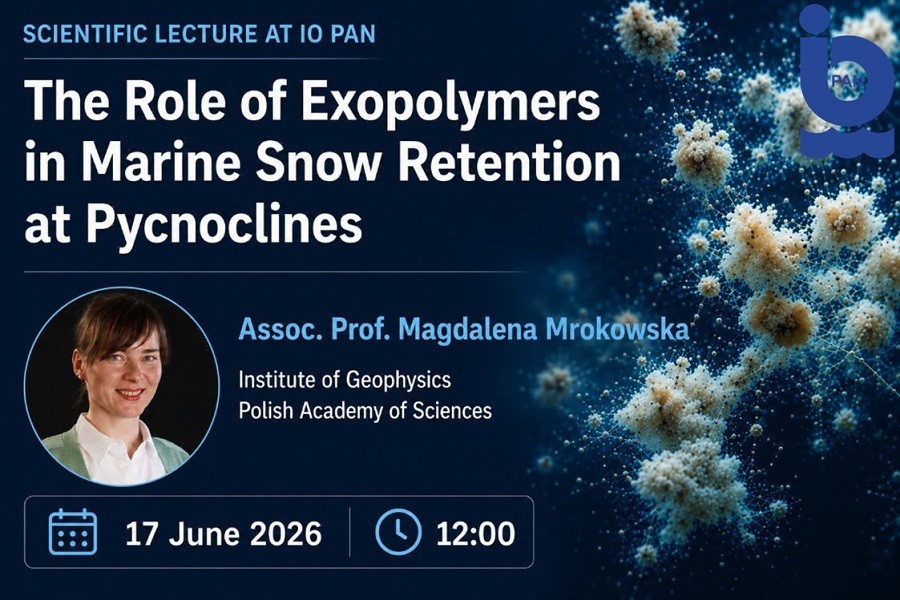
On 17 June 2026 at 12:00, the Institute of Oceanology of the Polish Academy of Sciences (IO PAN) will host a scientific lecture by Assoc. Prof. Magdalena Mrokowska (Institute of Geophysics, Polish Academy of Sciences), entitled 'The Role of Exopolymers in Marine Snow Retention at Pycnoclines'.
The seminar will explore the role of exopolymers (EPS) – substances secreted by algae and bacteria – in particle aggregation processes and the accumulation of marine snow at pycnoclines. The lecture will bring together concepts from marine physics, chemistry, and biology, presenting both field observations and laboratory experiments.
Dr. Magdalena Mrokowska specializes in research on particle transport in marine and riverine environments, as well as on the influence of exopolymers on the physicochemical properties of aquatic ecosystems. Her work combines visualization techniques, flow measurements, and rheological analyses to investigate sedimentation processes.
All interested participants are warmly invited to attend. Dr. Mrokowska will remain at the Institute until Thursday afternoon, providing an opportunity for individual meetings and scientific discussions.
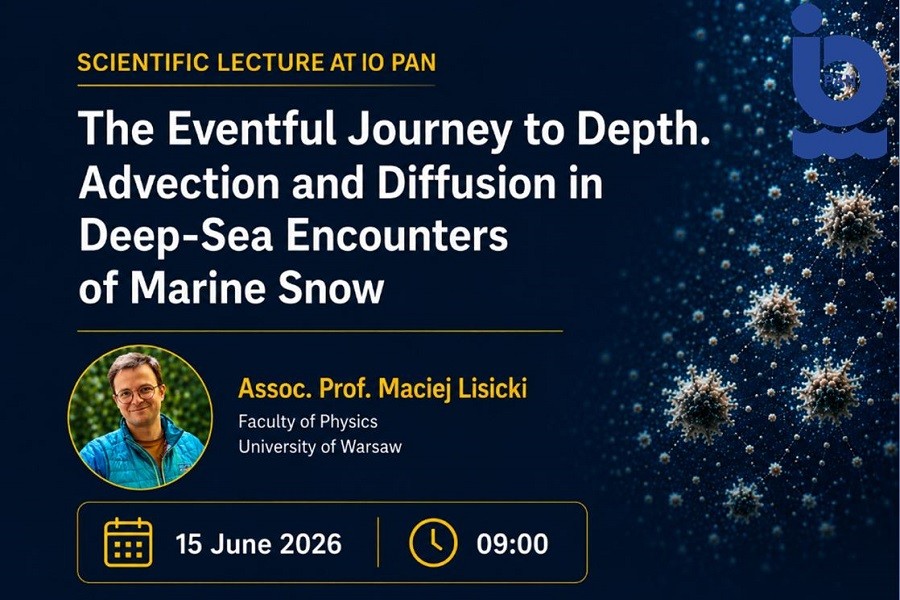
On 15 June 2026 at 9:00, the Institute of Oceanology of the Polish Academy of Sciences (IO PAN) will host a scientific lecture by Assoc. Prof. Maciej Lisicki (Faculty of Physics, University of Warsaw), entitled 'The Eventful Journey to Depth. Advection and Diffusion in Deep-Sea Encounters of Marine Snow'.
Marine snow lies at the intersection of physics, biology, and climate science. During the lecture, Dr. Lisicki will present recent findings on how sinking particles encounter microbes and other suspended matter in the ocean. Particular attention will be given to the role of microscopic diffusion, which, despite the presence of strong advective flows, may significantly enhance encounter rates between particles. These processes are crucial for understanding the efficiency of the ocean’s biological carbon pump and the fate of carbon in marine ecosystems.
Dr. Maciej Lisicki is a theoretical physicist specializing in soft and active matter physics, complex systems, and biological fluid mechanics. He leads a research group at the Faculty of Physics, University of Warsaw. His research focuses on microscale transport phenomena, including the motion of microorganisms and the interactions between biological activity and fluid flows. After completing his PhD at the University of Warsaw, he spent nearly four years at the University of Cambridge, where he investigated the physics of bacterial swimming. His interests also extend to the physics of everyday phenomena and natural fluid systems.
All interested participants are warmly invited to attend. Dr. Lisicki has kindly agreed to remain at the Institute for several hours after the lecture, providing an opportunity for scientific discussions and exploring potential avenues for future collaboration.
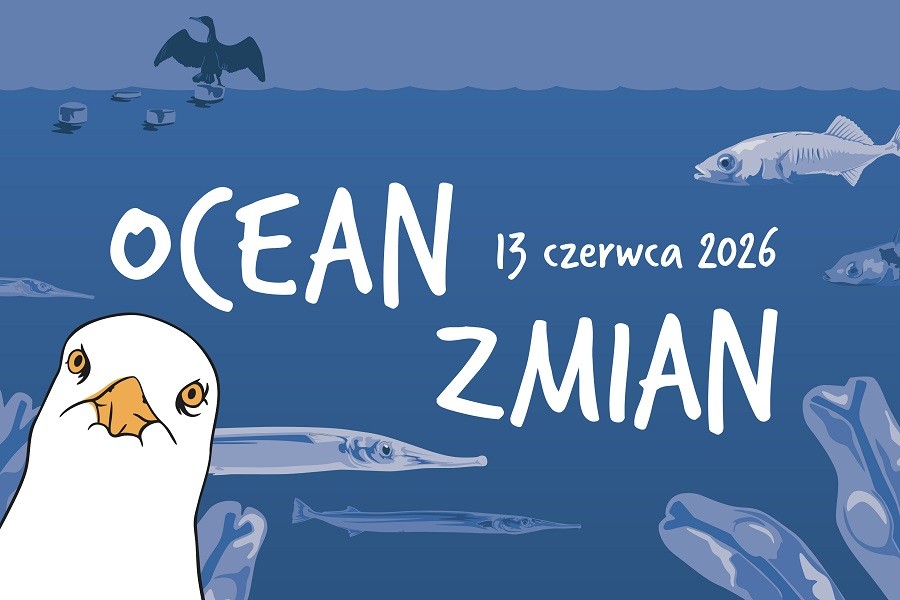
The Institute of Oceanology of the Polish Academy of Sciences invites you to the Sopot Science Day 'Ocean of Change' 2026, which will take place on 13 June 2026 at the Institute of Oceanology in Sopot.
The programme will include meetings with scientists, workshops, demonstrations, and activities promoting knowledge about the sea and environmental changes in the Baltic Sea.
Event details are available on Facebook:
'Sopot Science Day ‘Ocean of Change’ 2026' event
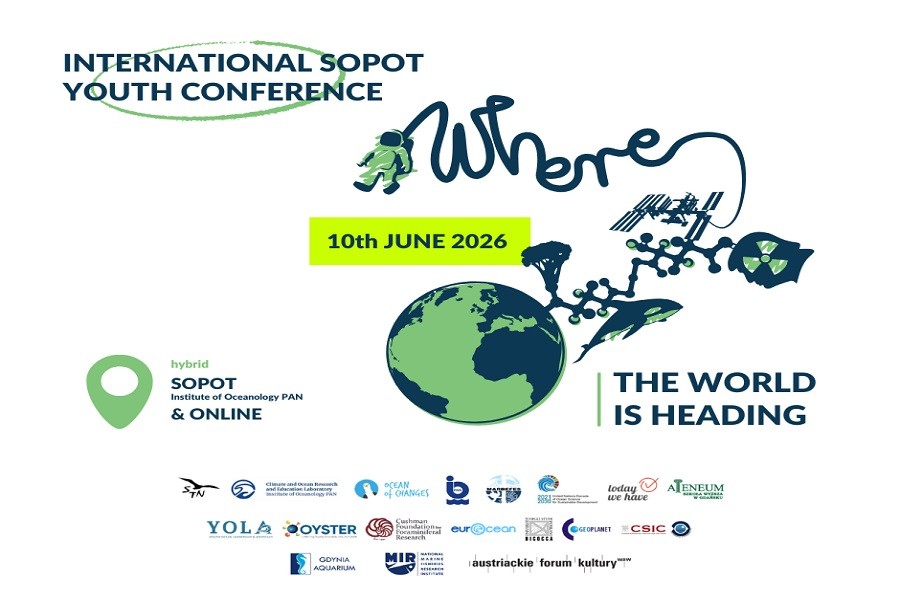
The Institute of Oceanology of the Polish Academy of Sciences cordially invites you to participate in the International Sopot Youth Conference (ISYC 2026), which will take place on 10 June 2026 at the Institute of Oceanology in Sopot, Poland.
The conference is aimed at undergraduate and graduate students, PhD candidates, and early-career researchers. Participants will have the opportunity to present their research findings, ideas, and experiences within two thematic tracks: Humanities and Social Sciences and Natural and Exact Sciences.
The event will be held in a hybrid format, allowing both in-person and online participation. We particularly encourage attendees to join the interdisciplinary session dedicated to inclusivity in science, which will provide a platform for exchanging perspectives and experiences across different disciplines.
The conference proceedings will be published with an ISBN number, enabling participants to cite their contributions in future scientific publications. As in previous editions, the authors of the best presentations will be recognized with awards.
This year's edition of the conference is organized in cooperation with the EU Erasmus+ YOLA project initiative.
More information are available on the Conference website.
We warmly invite you to join us!
On 21 April 2026, the Institute of Oceanology of the Polish Academy of Sciences (IO PAN) signed a Memorandum of Understanding (MoU) with the Korea Polar Research Institute (KOPRI), based in Incheon, Republic of Korea.
The agreement marks a new stage in scientific cooperation between the two institutions, creating new opportunities for Arctic research, particularly in the fields of environmental change, marine ecosystem functioning, biogeochemical cycles, and long-term variability of the Arctic environment.
The cooperation will include, among other activities, the exchange of scientific knowledge and data, mobility opportunities for researchers and students, participation in joint research cruises and fieldwork, as well as the preparation of joint research projects and scientific publications.
The MoU was signed by the Director of IO PAN, Prof. Sławomir Sagan, and the President of KOPRI, Dr Hyoung Chul Shin.
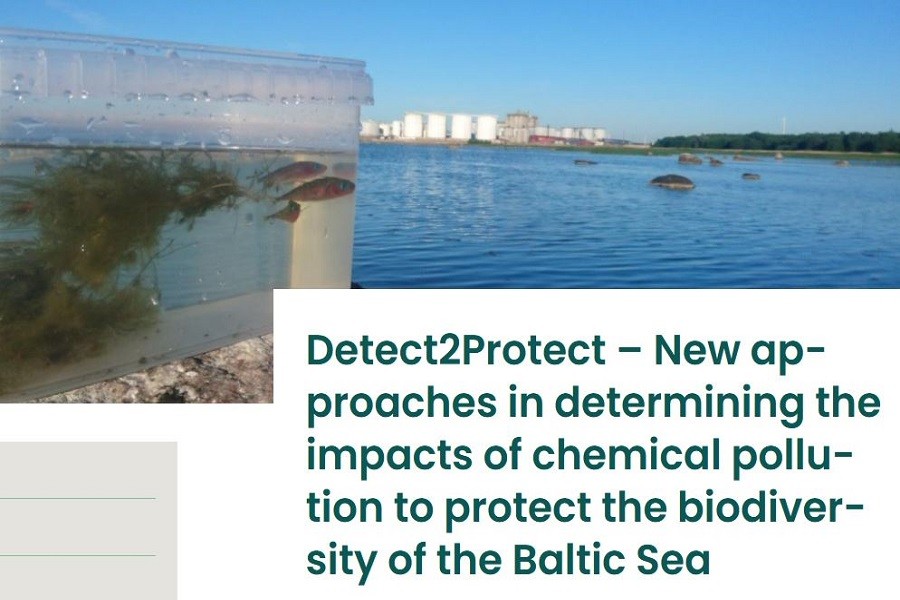
The Institute of Oceanology of the Polish Academy of Sciences invites you to an international stakeholder seminar organised as part of the BIODIVERSA+ project Detect2Protect entitled 'New approaches in determining the impacts of chemical pollution to protect the biodiversity of the Baltic Sea'.
The meeting will take place on 20 May 2026 (Wednesday), from 13:00 to 15:00 (CET) and will be held online via MS Teams.
The Detect2Protect project, implemented by an international consortium, aims to develop innovative methods for monitoring and assessing the state of the marine environment, as well as to improve understanding of the links between chemical pollution and biodiversity loss in the Baltic Sea. The project promotes a more holistic approach based on so-called effect-based methods (EBM), enabling a better assessment of pollution impacts.
The seminar will provide an opportunity to learn more about the project, exchange knowledge, and engage in discussion with scientists and stakeholders involved in marine environmental protection.
Those interested in participating are kindly asked to register by 11 May 2026 via email: pazdro@iopan.pl. A link to the meeting will be sent to all registered participants.
More information about the project (including three newsletters published so far)