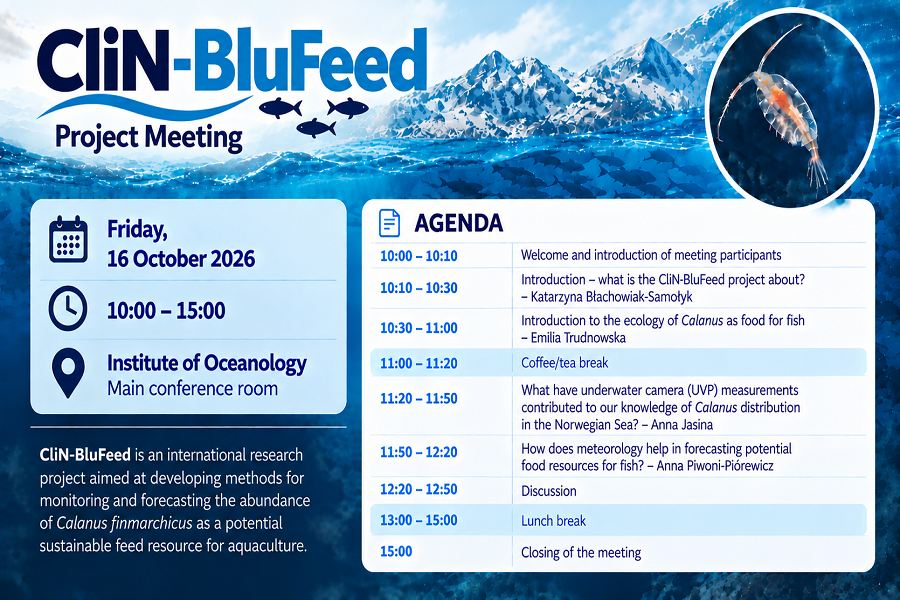
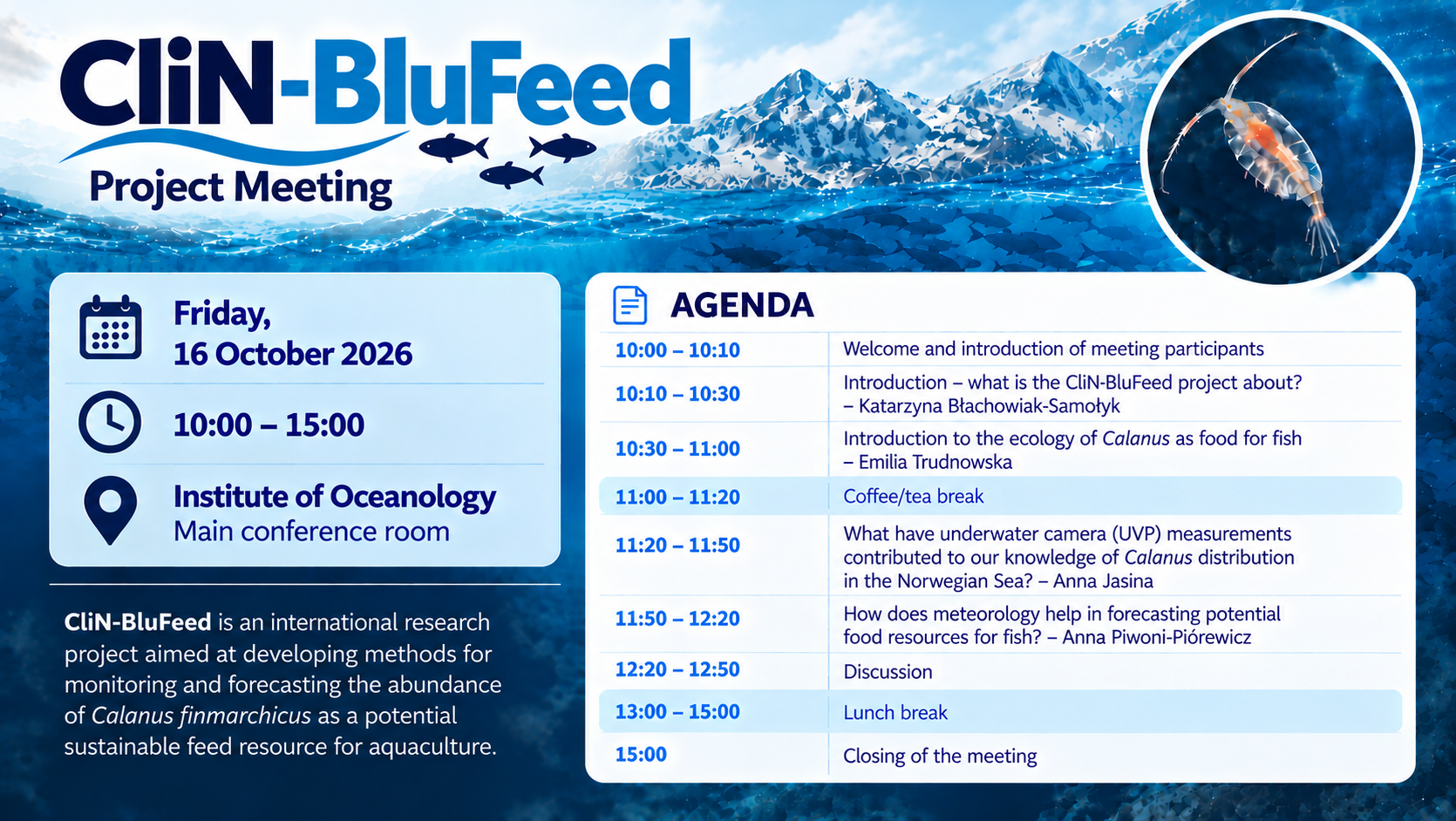
On 16 October 2026, a meeting dedicated to the CliN-BluFeed project will take place at the Institute of Oceanology of the Polish Academy of Sciences in Sopot. The event will provide an opportunity to present the project's objectives, discuss ongoing research, and exchange knowledge and experience among participants.
The meeting programme will include presentations on the ecology of copepods of the genus Calanus and their importance as a food source for fish, as well as the use of underwater cameras (UVP) to investigate the distribution of Calanus in the Norwegian Sea. The role of meteorology in forecasting potential food resources for fish will also be discussed.
The meeting will begin at 10:00 a.m. in the main conference room of the Institute of Oceanology. Presentations will be delivered by Prof. Katarzyna Błachowiak-Samołyk, Assoc. Prof. Emilia Trudnowska, MSc. Anna Jasina and PhD. Anna Piwoni-Piórewicz. The programme will also include a discussion of the topics presented and opportunities for further collaboration.
The meeting will provide an opportunity to discuss the processes influencing the availability of food resources for fish, as well as methods for monitoring and forecasting these resources.
CliN-BluFeed is an international research project involving partners from Norway (led by APN), Poland, Germany, Portugal, and Cyprus. Its aim is to develop methods for monitoring and forecasting the abundance of copepod Calanus finmarchicus as a potential sustainable feed resource for aquaculture.
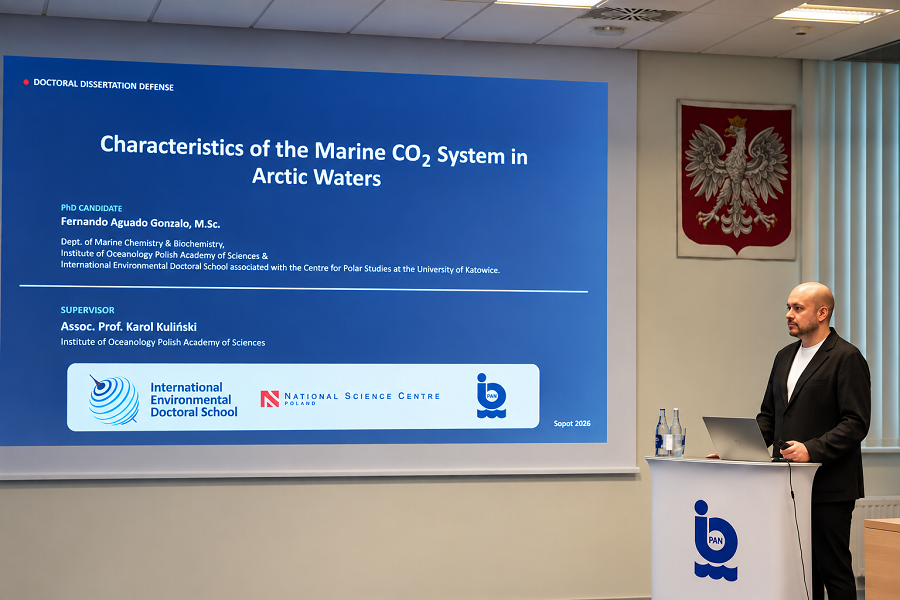
We are pleased to announce that on 7 October 2026, M.Sc. Fernando Aguado Gonzalo successfully defended his PhD dissertation, entitled 'Characteristics of the marine CO₂ system in Arctic waters'.
The dissertation, focused on the study of the marine carbonate system in Arctic waters, was prepared under the supervision of Assoc. Prof. Karol Kuliński.
The dissertation was reviewed by Prof. David Turner from the University of Gothenburg, Assoc. Prof. Katarzyna Łukawska-Matuszewska, from the University of Gdańsk, and Prof. Aleksander Astel from Pomeranian University in Słupsk.
Warmest congratulations to Fernando on his successful PhD defence!
We wish him continued scientific success, inspiring research projects, and many exciting new discoveries.
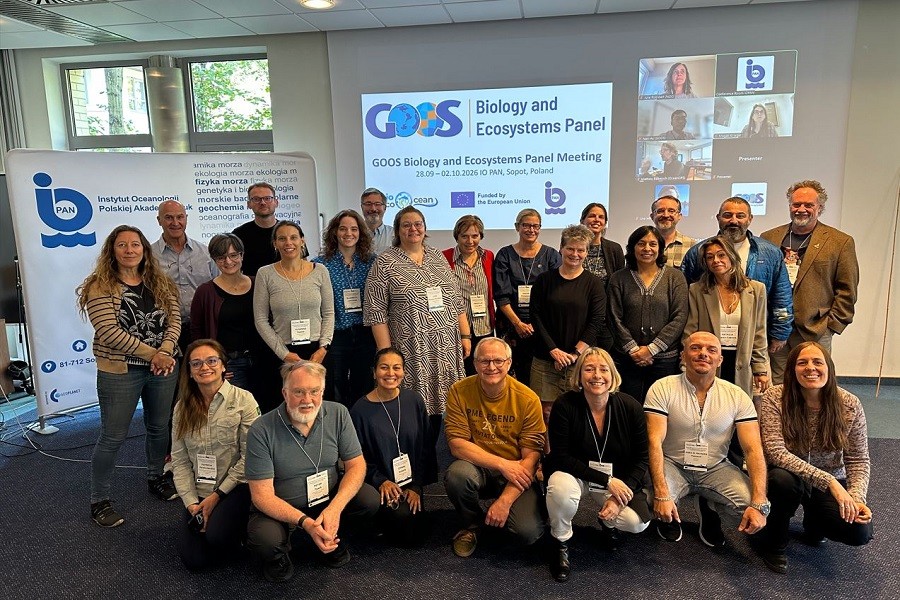
From 28 September to 2 October, the Institute of Oceanology of the Polish Academy of Sciences (IO PAN) in Sopot hosted an international meeting of experts from the Global Ocean Observing System (GOOS) Biology & Ecosystems Panel. Our Institute was pleased to welcome scientists from Australia, Asia, Africa, South and North America, and Europe. It also served as a global meeting venue to advance biological and ecosystem ocean observing.
The GOOS BioEco Panel coordinates the activities of existing observing networks within the global community working on biological and ecosystem ocean observations. The Panel also oversees implementation, updates and advancing biological and ecosystem-related Essential Ocean Variables (EOVs). Its work aims to advance our understanding of marine life and support the achievement of global goals for sustainable development and nature conservation.
During the meeting in Sopot, the Panel:
- developed a short-term implementation plan for the GOOS Biodiversity Strategy,
- improved alignment on minimum metadata standards between the IOC Ocean Biodiversity Information System (OBIS) and OceanOPS (WMO-IOC/UNESCO),
- discussed the role of the Panel in the GOOS endorsement process of ocean best practices,
- strategized on improving awareness and use of the BioEco Essential Ocean Variables.
Later this year, GOOS will also release the updated BioEco Essential Ocean Variable Specification Sheets - bringing together the collective work of the whole GOOS BioEco community and the BioEcoOcean project, to which IOPAN is strongly contributing.
The meeting was supported by the BioEcoOcean project, funded by the European Union’s Horizon Europe programme.
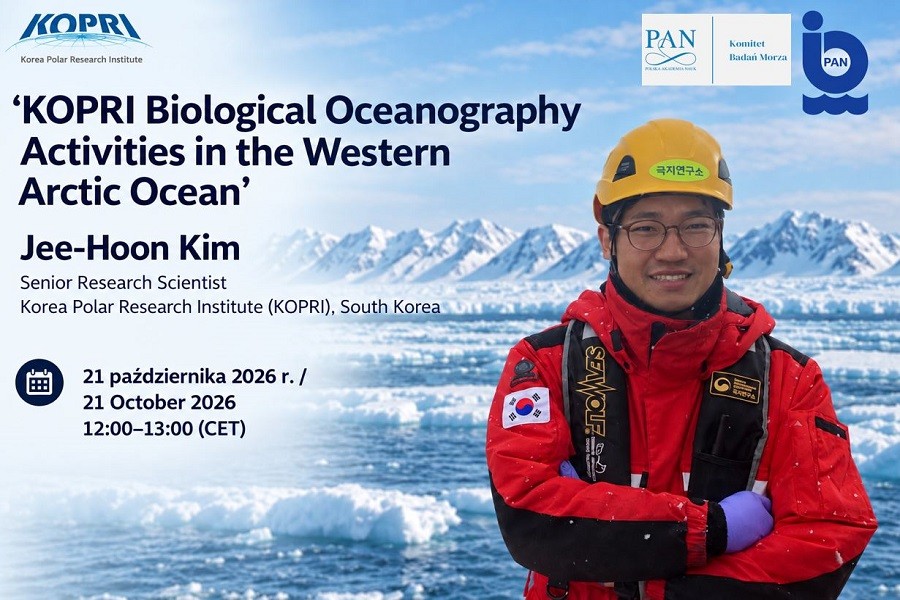
From 19 to 23 October 2026, the Institute of Oceanology of the Polish Academy of Sciences (IO PAN) will host Dr. Jee-Hoon Kim, Senior Research Scientist at the Korea Polar Research Institute (KOPRI), South Korea.
As part of his scientific visit*, we invite you to attend the seminar, organized by IO PAN and Biological Section of Committee for Oceanic Research of Polish Academy of Sciences, entitled ‘KOPRI Biological Oceanography Activities in the Western Arctic Ocean’, during which Jee-Hoon Kim will present biological oceanography research conducted by KOPRI in the Pacific Arctic Ocean, with a particular focus on recent field research and observations from the 2026 Arctic expedition (Abstract).
Date: 21 October 2026 (Wednesday), 12:00–13:00 CET
Venue: Main Seminar Room, IO PAN
The seminar will be held in a hybrid format. Those unable to attend in person are welcome to join online via Zoom.
Zoom:
https://us06web.zoom.us/j/86885752634?pwd=WfJx7fQ0oJNSnganhS3tWGiTa4taA1.1
Meeting ID: 868 8575 2634
Passcode: 820387
Everyone is warmly invited!
*The visit was co-financed by the Polish Academy of Sciences as part of international cooperation (study visits at the Polish Academy of Sciences).
On Friday, 25 September 2026, we took part in the Pomeranian Researchers’ Night – a unique event that provides an opportunity each year to talk about science in a less formal atmosphere.
Hosted by the Experyment Science Centre in Gdynia, we prepared a stand dedicated to the Baltic Sea and the oceans. Through educational games, we invited visitors to discover the mysteries of the sea, learn about its inhabitants, and explore the challenges facing marine ecosystems today.
It was a great opportunity not only to have fun together, but above all to share knowledge and promote ocean literacy among both younger and adult visitors to our stand.
Researchers’ Night is a European science outreach event held annually, traditionally on the last Friday of September, in many European Union countries. Its aim is to bring science and the work of researchers closer to the general public and to show that science can be a fascinating adventure.
The Tri-City Researchers’ Night project 'Research4Resilience' received funding under the MSCA & Citizens call of the Horizon Europe programme. The Institute of Oceanology of the Polish Academy of Sciences is a member of the consortium, which is coordinated by the Medical University of Gdańsk.
Photos
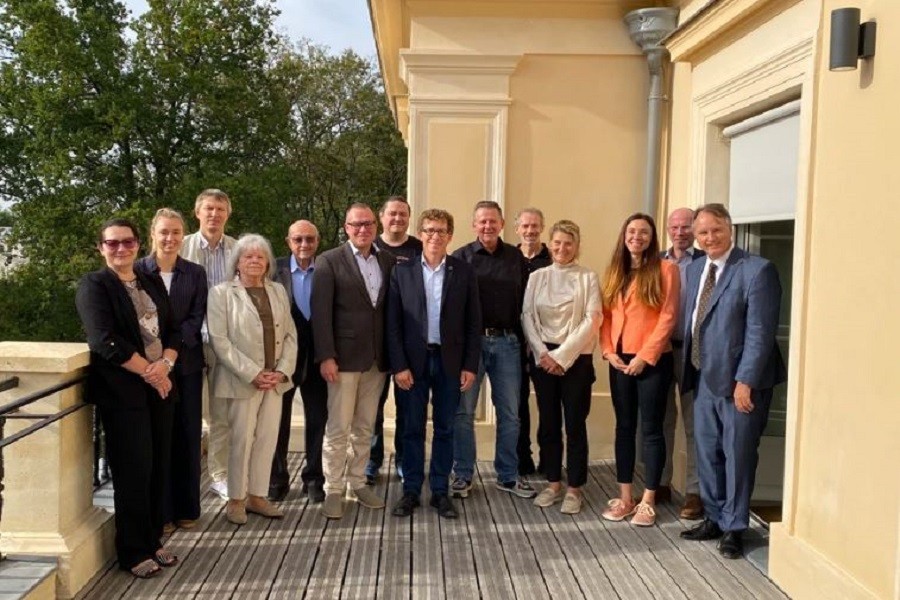
On 24 September 2026, the inaugural meeting of the UArctic Regional Centre Continental Europe took place in Versailles, France. Prof. Monika Kędra participated in the meeting, representing the Institute of Oceanology of the Polish Academy of Sciences.
The meeting brought together representatives of institutions and organisations from nine European countries. The discussions focused on the activities and further development of the new UArctic Regional Centre, which aims to strengthen cooperation between institutions in continental Europe and Arctic partners. Topics discussed included joint research and educational initiatives, opportunities for developing collaborative projects, and activities aimed at raising awareness and sharing knowledge about the Arctic.
Prof. Monika Kędra’s participation in the meeting reflects the Institute of Oceanology PAS’s active involvement in international scientific cooperation related to the polar regions.
More information about the meeting is available on the UArctic website.