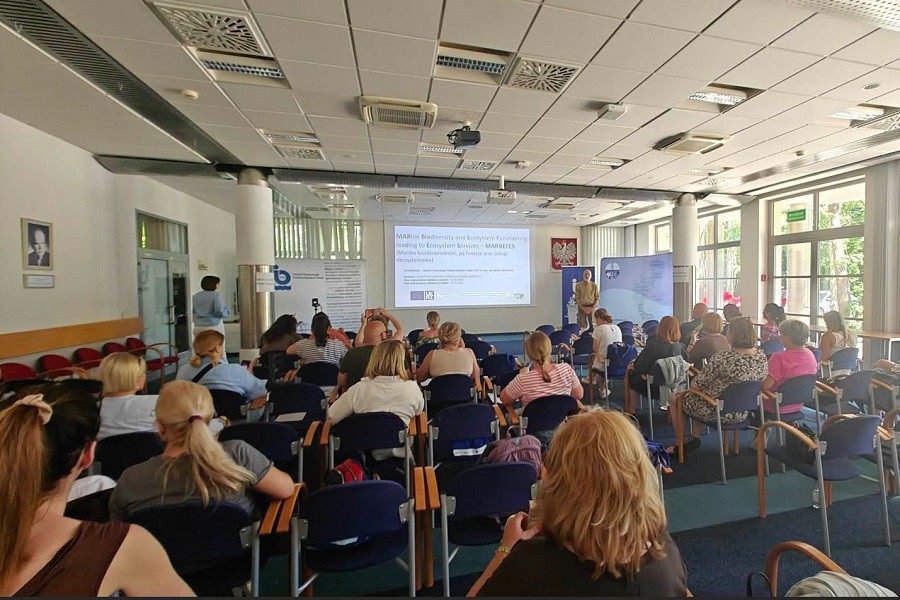
During May and June 2026, the Institute of Oceanology of the Polish Academy of Sciences (IO PAN), within the framework of the MARBEFES project, organised a series of Coastal Watch activities in the Gdańsk Bay region. The events brought together scientists, environmental authorities, NGOs, artists, students and local communities to promote marine biodiversity conservation and strengthen stakeholder engagement. The programme included a BioBlitz-inspired event, field workshops on coastal biodiversity and a training session for environmental practitioners, demonstrating how MARBEFES research supports evidence-based coastal ecosystem management.
We are pleased to announce the publication of a new video presenting the SEABAS (Sea Basin Planning Support) project, implemented under the Interreg Baltic Sea Region Programme.
The video highlights the key challenges related to integrating environmental considerations into maritime spatial planning in the Baltic Sea and presents the actions undertaken by the project partners to address them. In the video, SEABAS partners explain the project's objectives and discuss the benefits it brings to the Baltic Sea region.
The Institute of Oceanology of the Polish Academy of Sciences (IO PAN) is a partner in the SEABAS project and actively contributes to activities supporting sustainable maritime spatial planning based on scientific knowledge and the protection of marine ecosystems.
For more information about the project, please see:
“Integrating the Environmental Component into the Baltic Sea MSP Puzzle”
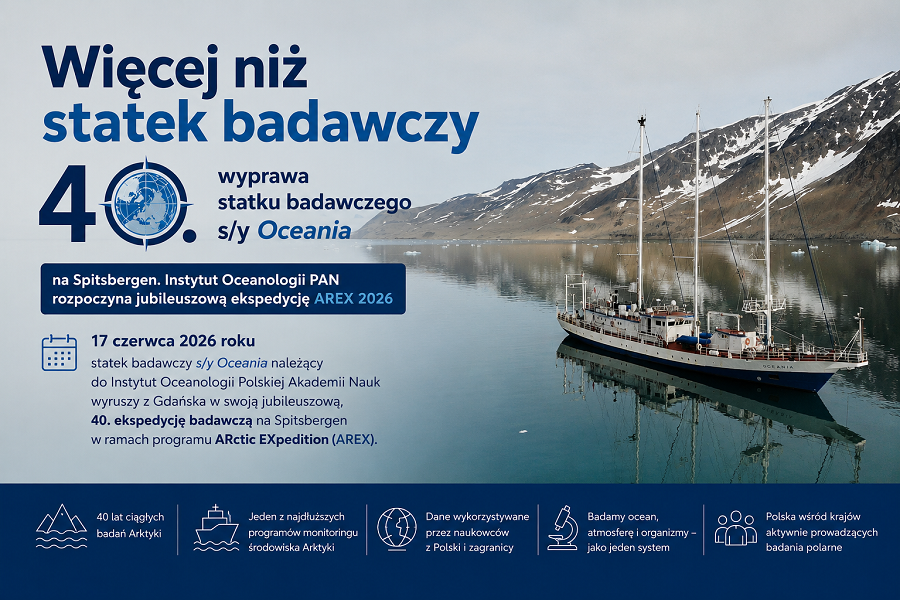
On 17 June 2026, the 40th anniversary AREX research expedition to Spitsbergen will set sail from Gdańsk aboard the research vessel s/y Oceania, operated by the Institute of Oceanology of the Polish Academy of Sciences (IO PAN). This milestone marks four decades of uninterrupted Arctic research conducted by the Institute’s scientists.
AREX is one of the longest-running Polish observation programmes in the Arctic. Thanks to regular measurements carried out since 1987, scientists have been able to track the pace and scale of environmental changes occurring in one of the world’s most sensitive regions. The anniversary expedition represents another important step in continuing this unique long-term research effort.
A special place in this story belongs to Oceania herself – a unique research vessel launched in 1985 that combines the characteristics of a sailing ship and a modern scientific platform. Thanks to her design, she is capable of conducting research both in the open ocean and in the hard-to-access coastal regions of the Arctic. For more than 40 years, she has supported hundreds of scientists carrying out projects in oceanography, marine biology, environmental chemistry and climatology, becoming a symbol of Polish marine and polar research. In recent years, Oceania has also become an important platform for education and science communication. Her deck has hosted international schools for students and early-career researchers, art–science projects, documentary film and television productions, as well as a wide range of activities promoting knowledge about the seas, oceans and climate change.
During this year’s expedition, scientists will conduct oceanographic, biological, biogeochemical, atmospheric, optical and acoustic studies aimed at monitoring ongoing changes in the European Arctic and improving our understanding of how marine ecosystems function under conditions of accelerating climate change.
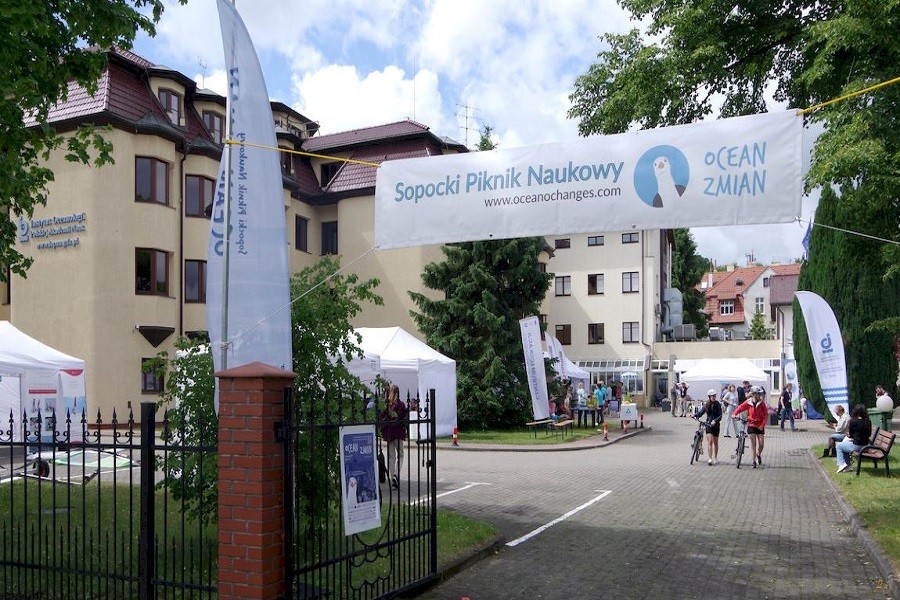
On 13 June 2026, another edition of the Sopot Science Day took place. Once again, the event attracted numerous science enthusiasts and demonstrated that science can be fascinating, entertaining, and inspiring.
At 31 exhibition stands, researchers from the Institute of Oceanology of the Polish Academy of Sciences (IO PAN) and representatives of 20 partner institutions showcased their research, scientific passions, and engaging experiments. Despite the changeable weather, more than 900 visitors had the opportunity to step into the role of scientists, conduct experiments themselves, talk with experts, and attend a variety of interesting lectures and demonstrations.
We would like to thank all exhibitors, volunteers, partners, and guests for spending this special day with us and helping to create the unique atmosphere of the event. We look forward to seeing you at the next edition of the Sopot Science Picnic!
Photo galleries from the event:
https://old.iopan.pl/Albumy/Piknik2026_TK/index.html
https://old.iopan.pl/Albumy/Piknik2026/index.html
We are pleased to announce that the projects C-SCALE (Project Leader: Dr. Katarzyna Koziorowska) and BluePaths (Project Leader: Assoc. Prof. Karol Kuliński) have been awarded funding under the JPI Oceans Joint Call on Blue Carbon Ecosystems 2025. Both projects will be carried out within international research consortia.
The JPI Oceans Blue Carbon Ecosystems call focuses on advancing scientific knowledge, improving methodologies and measurement protocols, and identifying effective actions to enhance the capacity of blue carbon ecosystems to contribute to climate change mitigation.
This achievement is particularly noteworthy given the highly competitive nature of the call. Out of 24 submitted proposals, only 4 projects were recommended for funding, 2 of which involve researchers from the Institute of Oceanology of the Polish Academy of Sciences.
We warmly congratulate the project leaders and everyone involved in the preparation of the successful proposals. We wish them every success in the implementation of their projects, fruitful collaboration with international partners, and many exciting scientific outcomes.
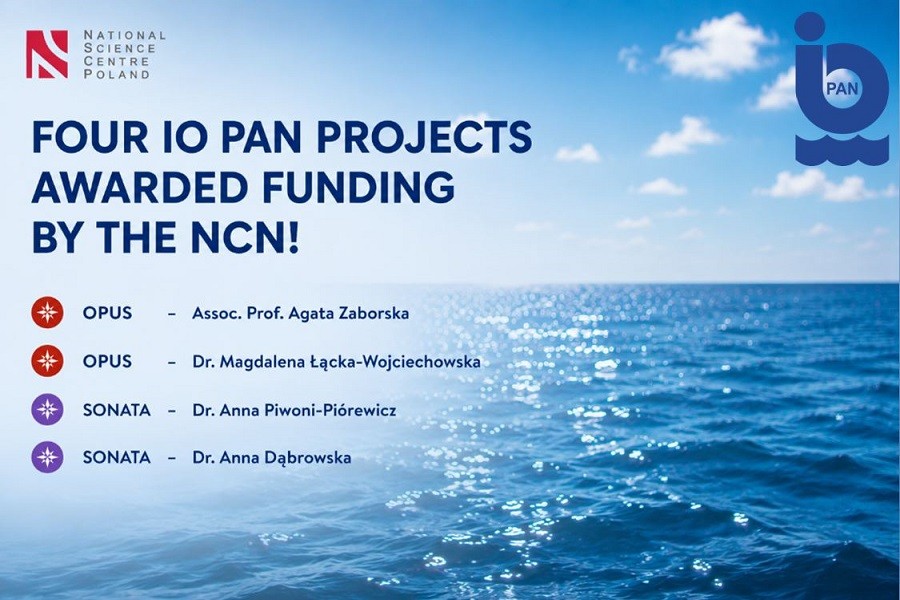
The National Science Centre (NCN) has announced the results of the OPUS 30 and SONATA 21 funding calls. We are pleased to share that four research projects led by scientists from the Institute of Oceanology of the Polish Academy of Sciences (IO PAN) have been selected for funding.
The awarded projects are led by:
The OPUS programme is open to researchers at all stages of their scientific careers, while SONATA supports early-career scientists in establishing and developing their own research teams. This year’s edition attracted record interest, with more than 3,700 proposals submitted to the NCN, making it the largest competition in the history of these funding schemes.
We warmly congratulate the Project Leaders on this outstanding achievement and wish them every success in carrying out their research, as well as many rewarding scientific discoveries and results.